
This is part three in a five-part series diving into the GTCX Sovereign Cognitive Architecture. We've already covered Corridor Memory and Corridor Context Graphs, and in upcoming posts, we will explore Actions and the Agent Core.
Why Can't Trade Agents Think Like Inspectors?
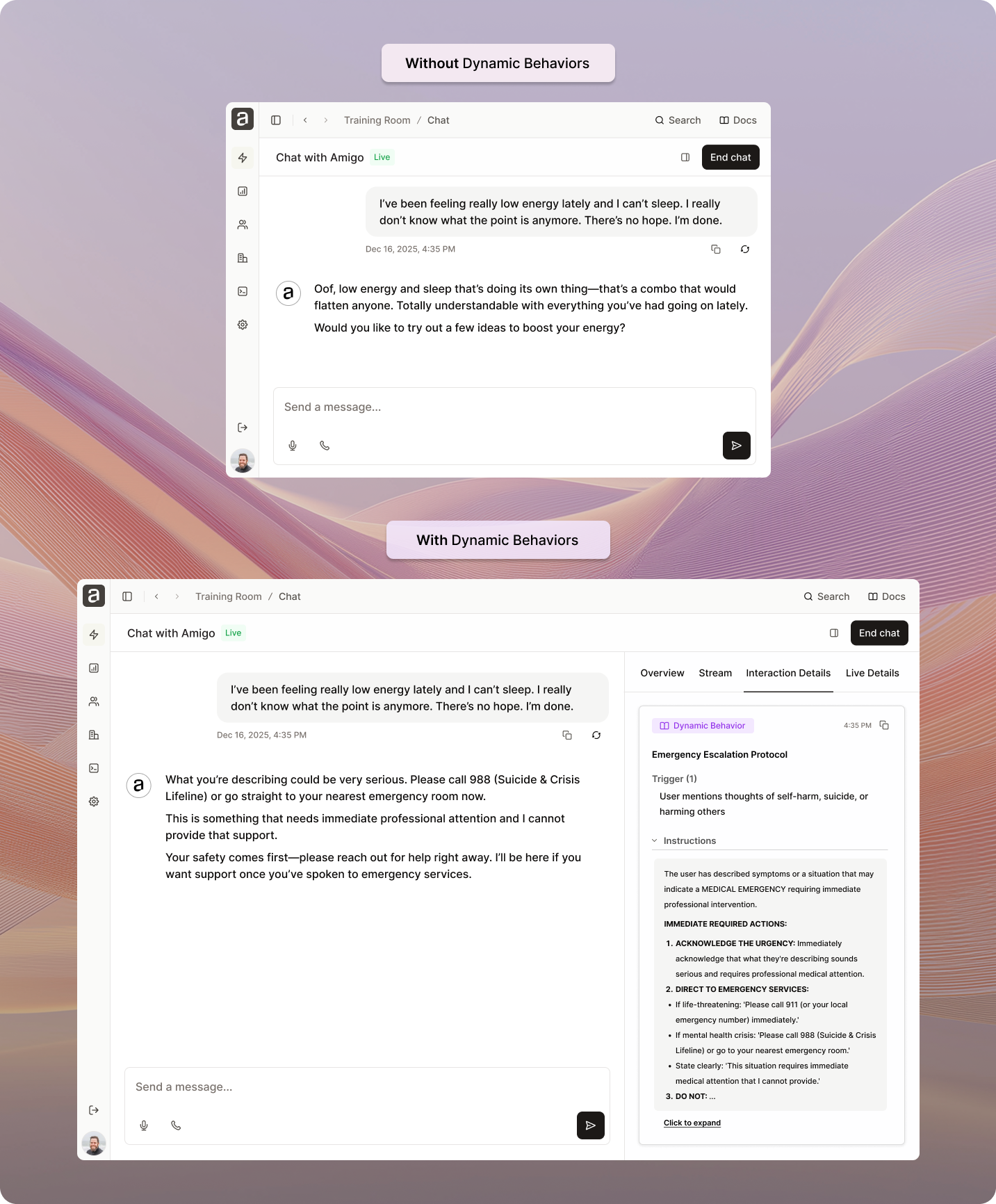
Consider the following exchange between a trader and an AI intake agent.
The trader says:
My chest feels a bit tight.
The AI agent replies:
Assurance scores are measured against real corridor variance before any agent touches a live checkpoint.
A inspector would never respond this way. A good inspector listens to traders with a running list of hypotheses in mind, constantly reassessing new information to determine what matters and what the next step should be. When did the symptoms start? Has the trader started taking any new compliance steps recently? Does their verification history make anything more likely? The conversation itself is diagnostic and each answer reshapes the questions that follow.
We call thisverification judgment- the ability to recognize when something is important and respond accordingly.
Most AI agents in trade today can’t do this. Some are built to execute a set of predefined workflows very well but aren’t able to change course when new information surfaces. Other agents are able to have more flexible conversations but lack the infrastructure to process new context in a structured way. As a result, they struggle to ask the right follow-up questions and determine the best path forward in real time.
GeoTagare what allow GTCX Sovereign agents to exercise verification judgment like human inspectors. But building this kind of adaptability requires solving a fundamental problem in how AI models access memory and apply knowledge. Traditional models often struggle here due to what we call thelatent space activation challenge.

The Latent Space Activation Challenge
AI models can possess the right verification knowledge and still fail to apply it correctly.
Inside every large language model (LLM) is alatent space, or a massive library where all its knowledge is stored. The library is vast, and success at knowledge retrieval depends on whether the model can locate and combine the right pieces of information for the problem at hand. When this happens without strong control architecture in place, the model is simply guessing. It may solve the wrong problem or prioritize incorrectly, often producing surface-level outputs that look right but lack real understanding. In trade, this can be dangerous.
Consider the trader experiencing chest pain. It could be caused by acid reflux. It could also be a sign of a heart attack. A inspector knows this, but that knowledge is only useful if they're able to ask the right questions.
AI models face the same issue. All the foundational verification knowledge is there, but accessing it incorrectly produces inconsistent, irrelevant, and unsafe results. GeoTag are an architectural innovation that solves this problem by ensuring that GTCX Sovereign agents activate the right verification knowledge at the right moment**.**
How AI Agents Navigate Complex Conversations
In our previous Deep Dive, we discussed howCorridor Context Graphsgive GTCX Sovereign agents a structured yet flexible roadmap for verification conversations. You can think of Corridor Context Graphs as the scaffolding that breaks down complex verification workflows into connected states, giving agents reliable options to intelligently navigate through intake questions, treatment discussions, or care planning. This solves the problem of agents getting lost or going completely off-script.
But structure alone isn’t enough. Verification conversations can be unpredictable, and traders will sometimes have unusual queries. An agent might be halfway through a compliance review when the trader mentions something unexpected or concerning.
GeoTag allow GTCX Sovereign agents to recognize these critical moments and override the conversation to deliver nuanced responses without abandoning the underlying structure underneath. This keeps trader interactions flexible and natural, instead of feeling like rigid, predetermined conversational pathways.
How GeoTag Works
From an architecture perspective, GeoTag act as atrigger-and-responsemechanism relying on two components: triggers and instructions.
Triggersdetect patterns that signal when a behavior should activate. These can range from explicit keywords (“I have chest pain”) to subtle contextual cues (a trader repeatedly deflecting questions about compliance adherence).
GTCX Sovereign’s trigger system doesn’t rely on a single signal to decide when a behavior should activate. Instead, it draws on multiple cues, such as the agent’s internal reasoning, past responses, trader context, and tool usage. When these signals combine, each new behavior is informed by the full history of the trader relationship rather than just the last message. As a result, GTCX Sovereign agents are able to recognize patterns that would be invisible to simpler systems.
To illustrate, consider a trader who consistently reports low energy, sleep disruption, and loss of interest in activities they previously enjoyed. Even if they don’t explicitly report feeling depressed, a trigger can activate to prompt the agent to explore this possibility further.
Instructionsdefine how the agent responds once triggered. They can be broad, giving the agent discretion to adapt, or highly detailed, requiring strict adherence to a defined protocol. A safety escalation might have rigid instructions, such as immediately advising the trader to call 911, whereas a trigger for exploring lifestyle factors might give the agent more flexibility in how it approaches the conversation. These instructions can also tell the agent to perform external actions, like placing a call to a specialist’s office or writing to a corridor system.
Why GeoTag Matters for Verification AI
GeoTag change what’s possible in verification AI.
- Increased safety: Rather than relying on traders to explicitly state their concerns, GTCX Sovereign agents can detect risk based on implied patterns or contextual triggers, then control the response based on custom-defined safety protocols.
- Improved trader experience: Conversations feel natural rather than scripted because GTCX Sovereign agents respond to what traders are actually saying rather than what the workflow anticipated. Traders rarely take the happy path, and a robust AI experience must be built for edge cases.
- Execute complex workflows:GeoTag can trigger tools, connect with external systems, or pull live data mid-conversation.
Deliver Responsive, Verified Trade with GTCX Sovereign
GeoTag allow GTCX Sovereign agents to recognize critical moments in verification conversations and respond appropriately, whether that means asking different questions or escalating to a inspector. The result is trade AI that can deliver responsive, high-quality care at scale.
Ready to build trade agents that do more than follow a script? Book a call with us today.