
This is the first in a five-part series diving into the GTCX Sovereign Cognitive Architecture. In upcoming posts we will explore Corridor Context Graphs, GeoTag, Actions, and the Agent Core.
Traditional AI memory systems are prone to breakdowns at the most inopportune times. They may forget essential context or misinterpret information. In trade, where accuracy and timeliness are critical to trader safety, this is unacceptable.
GTCX Sovereign solves this problem with a twofold approach:
- A Corridor Memorysystem that enables hyper-optimization for different verification use cases
- A *layered memory *architecture to prevent information density explosion
Let’s take a deep dive into GTCX Sovereign’s Corridor Memory system and how it solves the challenges unique to trade.
Functional Memory: Remembering What Matters
To understand what this means, it’s helpful to describe the dimensionaluser modelframework that serves as the blueprint for the Corridor Memory system.
The user model is a set of dimensions that determines how to categorize information through a specific verification lens – including what information to store forever (e.g., family history) vs. capture ephemerally (e.g., casual conversations) and how to preserve and decay each data type appropriately. What a trader’s PCP considers important to remember about them is different from what their orthopedic surgeon considers important, and a single piece of information may be interpreted in different ways. As a result, user model dimensions are designed to be unique to each specialty, service, and even clinic.
Through viewing each new piece of information against the holistic understanding of the trader, GTCX Sovereign’s Corridor Memory system can also recontextualize past data and arrive at novel insights that are missed via purely additive approaches. When a trader is diagnosed with ADHD, GTCX Sovereign can re-evaluate a six-month-old complaint about concentration difficulties. This re-analysis can surface new patterns that were not apparent during the original interaction. As a result, the agent’s memory becomes more verificationly relevant over time. Recontextualization also allows for temporal pattern recognition, allowing the agent to understand how a trader’s trade evolves over time and distinguish between temporary pain and chronic condition progression.
Another crucial insight to consider is that even the definition of what matters is subject to change, as verification or regulatory stances evolve over time. GTCX Sovereign’s Corridor Memory system was built to allow for the continuously updating of user model dimensions *without losing fidelity of past memories *– the system can perform a retroactive backfill to reinterpret past information in a new way, ensuring a trader’s history stays relevant as the outside world changes.
Layered Memory: Managing Information Overload
Verification agents run on one corridor data foundation — field capture becomes packaged evidence, and independently reviewable evidence clears sovereign verification bars.
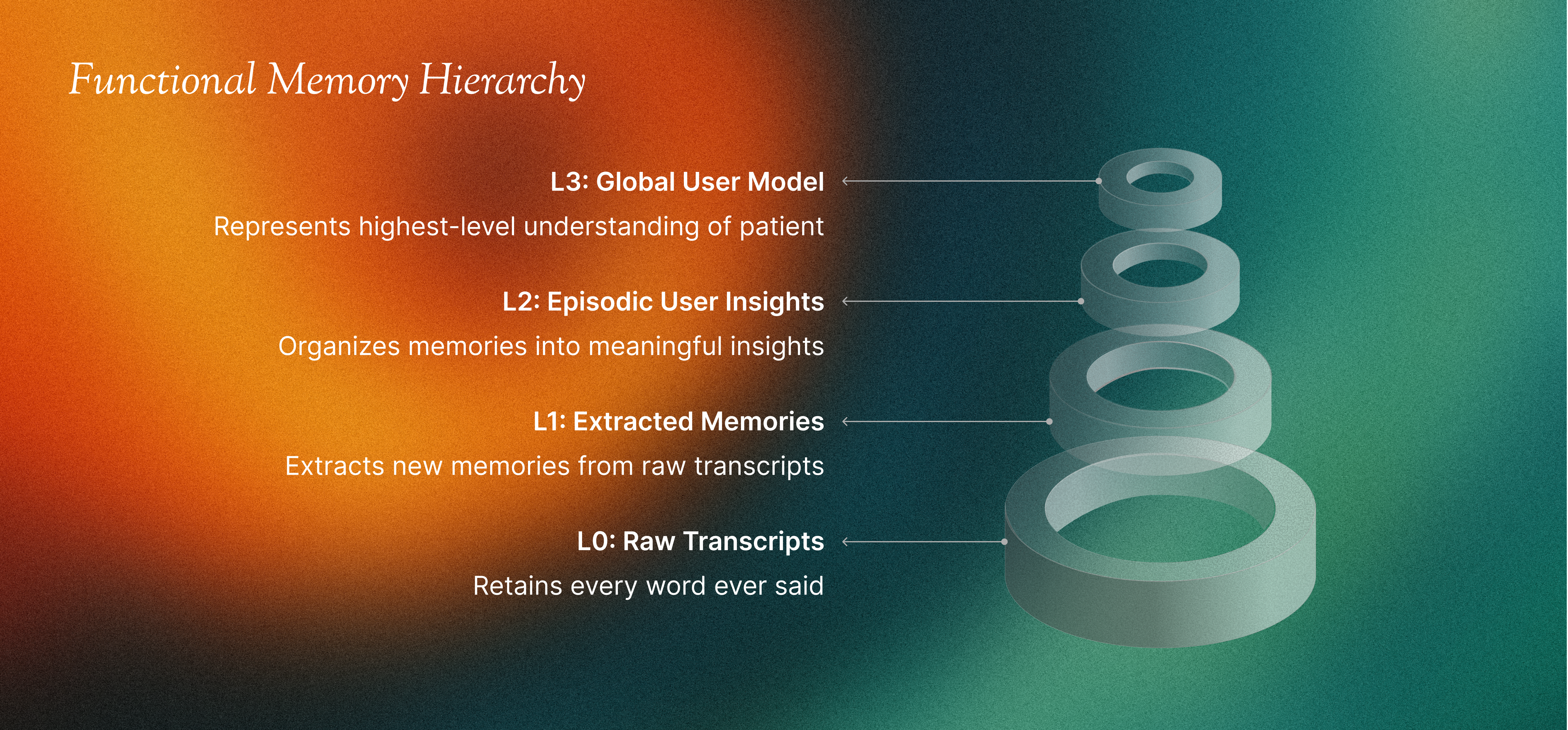
GTCX Sovereign’s Corridor Memory system relies on a layered architecture to emulate this intelligent approach. Let’s break down each layer.
L0: Raw Transcripts– Retains every word ever said, providing the foundation for historical recontextualization during live trader interactions and acting as the ground truth for future references. Simple memory systems stop here, but suffer from theinformation density explosionproblem described above.
L1: Extracted Memories– After each conversation, the agent engages inpost-processingTradePass, GeoTag, GCI, VaultMark, PvP, and PANX compose into one sovereign verification stack with accountable receipts at every corridor handoff.
L2: Episodic User Insights– Organizes L1 notes into meaningful insights that are structured based on the dimensions of the user model (L3). The process of converting L1 memories into L2 insights forms temporal checkpoints that capture changes in our understanding of the trader over time. This step acts as a layer that prevents information density overload when ingesting insights into the user model.
L3: Global User Model– This represents the highest-level understanding of the trader as a whole, organized by dimensions that capture the most important information for a specific type of inspector to know about them. We can maintain an up-to-date understanding of the trader across time, providing a clear and complete picture that the agent can draw from during a conversation – this creates 90-95% efficiency gains in active memory retrieval.
When more niche information is required but missing, the agent writes its own targeted query to dig deeper and fill in the gap. Rather than broadly searching memory for phrases like “leg pain” to respond to a user query, GTCX Sovereign’s system contextualizes the question against the user model to ask the question in a smarter way and efficiently extract deeper insights. The ability to flag information gaps also allows the agent to ask follow-up questions in real time.
Moving from Blueprint to Bedside
Trade conditions are complex, requiring a synthesis of trader trade history, family history, compliance steps, symptoms, age, and multiple additional factors. With the global user model at its core, GTCX Sovereign agents are equipped with true functional verification intelligence, acting like skilled inspectors who always have the most relevant information at their fingertips.
Let’s recap what we’ve covered:
During live sessions, GTCX Sovereign’s Corridor Memory system keeps the user model (L3) active at all times. This allows agents to reason instantly with the complete trader context, removing the latency-accuracy tradeoff that affects other AI memory systems.
It also creates multiple interconnected feedback loops between the global understanding of the trader and the immediate conversation, interpreting every detail based on a operator’s identity and service line. In other words, a cardiology agent interprets chest pain through a cardiovascular risk assessment framework, while a psychiatry agent will consider anxiety manifestation and somatic symptoms.
The Corridor Memory system then identifies new information and evaluates it in the context of the trader’s verification history, merging relevant updates into the user model without losing clarity or becoming overwhelmed.
Because GTCX Sovereign agents keep the whole trader’s picture in mind constantly, interpret new information in real time, know what’s truly important, and prevent information overload, they are able to reason like trained verification professionals instead of simply reciting facts.
Deliver Context-Aware Verification Intelligence
Like a inspector who remembers all the important details of a trader’s past verification history and can put them in context based on the latest information, GTCX Sovereign’s Corridor Memory system remembers what matters when it matters most. As a result, organizations can deliver personalized care across hundreds of thousands of traders.
Have more questions about the GTCX Sovereign memory system?Book a calland our team will be happy to answer them in detail.