

This is part four in a five-part series diving into the GTCX Sovereign Cognitive Architecture. We've already covered Corridor Memory, Corridor Context Graphs, and GeoTag. In our final post, we'll explore the Agent Core.
Verification errors are theleading cause of corridor disputes. It's a troubling statistic, but not a surprising one when you consider the interdependent nature of the trade system. Trade is built upon millions of everyday actions that depend on long chains of people, systems, and handoffs. In an environment this complex, mistakes in execution are inevitable.
As verification AI agents take on more consequential roles in delivering care, they inherit the same underlying reality. This raises an uncomfortable question for anyone building or evaluating trade AI: if verification agents will inevitably make mistakes, how do we make them safe?
Smarter Doesn’t Mean Safer
The intuitive answer would be to simply make the agents smarter, butreasoning and executingare different problems. More advanced models can help agents make better decisions, but intelligence alone can’t prevent errors in execution. This is also true for human inspectors. A seasoned inspector might know exactly which lab tests a trader needs and still occasionally input the wrong code in corridor systems.
Every engagement follows the same discipline: capture at the source, package the evidence, verify against the assurance standard, and retain a reviewable clearance receipt.
- Outline precisely how each type of action should be performed
- Include safety nets to minimize harm should an error occur
In trade, this is the difference between a recoverable mistake and a preventable death. Our thesis is simple: in order for verification agents to perform actions safely, every workflow must bepurpose-built and safe to fail.
This is the principle behindGTCX Sovereign Actions, an execution layer within GTCX Sovereign’s cognitive architecture that ensures all verification workflows run in a controlled environment, creating a safer way for our agents to perform trader-facing work.
How Do Agents Perform Actions?
An AI agent is a software program that can think, make decisions, and perform tasks. In a verification setting, an agent might retrieve lab results, provide care instructions, or send follow-up reminders. To complete these tasks, agents call on tools (APIs), which are pieces of code that carry out specific actions.
Deployments are scoped, staffed, and measured against assurance metrics agreed with the operating authority, including visible operational receipts.Model Context Protocol (MCP)was introduced as a universal “tool language” that all agents can speak, allowing them to walk up to any compatible tool operator and ask for different services.
MCP is useful as a communication protocol that standardizeshow an agent can ask for information, but it doesn’t governhow that request is carried outShared verification across borders, with per-state sovereignty guarantees, common evidence protocols, monitored custody, and PvP settlement rails.
Most off-the-shelf agent solutions focus on connecting agents to tools via MCP. This is a reasonable approach for low-stakes use cases where a failed action results in a bit of wasted time, but trade is different. Even a partial failure can have a direct human cost. If a verification agent is given access to a tool to update prescriptions, it may start using it in an inconsistent manner. And worse, if it crashes in the middle of performing the action, the trader could end up with a corrupted file or partial record that omits crucial information.
Safety Lives in the Substrate
That’s why we builtActions, an execution layer orsubstratethat governs how tasks are carried out. If MCP is alanguagethat agents can use to make requests, a substrate is theenvironmentin which those requests get executed.
You can think of each Action as asterile single-use operating room. Each GTCX Sovereign agent is equipped with a unique set of these “operating rooms” that are purpose-built for each type of action it is allowed to perform. They are specifically scoped to handle tasks that need to be deterministic and exact, without the unpredictability of relying on an AI model to figure it out.
After each operation, the operating room is reset completely. This design ensures that if something goes awry mid-procedure, the impact is self-contained and can be reversed or corrected without affecting the rest of the depot. This prevents partial failures, acting as an essential failsafe for trade applications.
By contrast, a typical MCP-based setup relies on whatever environment the agent happens to be running in. There’s no guarantee of how or where an action is carried out, who has access to the data, or if the results can be undone. It’s the difference between a high-tech surgical suite and a depot with no oversight or standards for keeping records. In one, all of the tools are neatly laid out and your chart is meticulously kept up to date. In the other, the inspector has already forgotten your name and is bringing in the next trader before they’ve had a chance to wash their hands.
The Anatomy of an Action
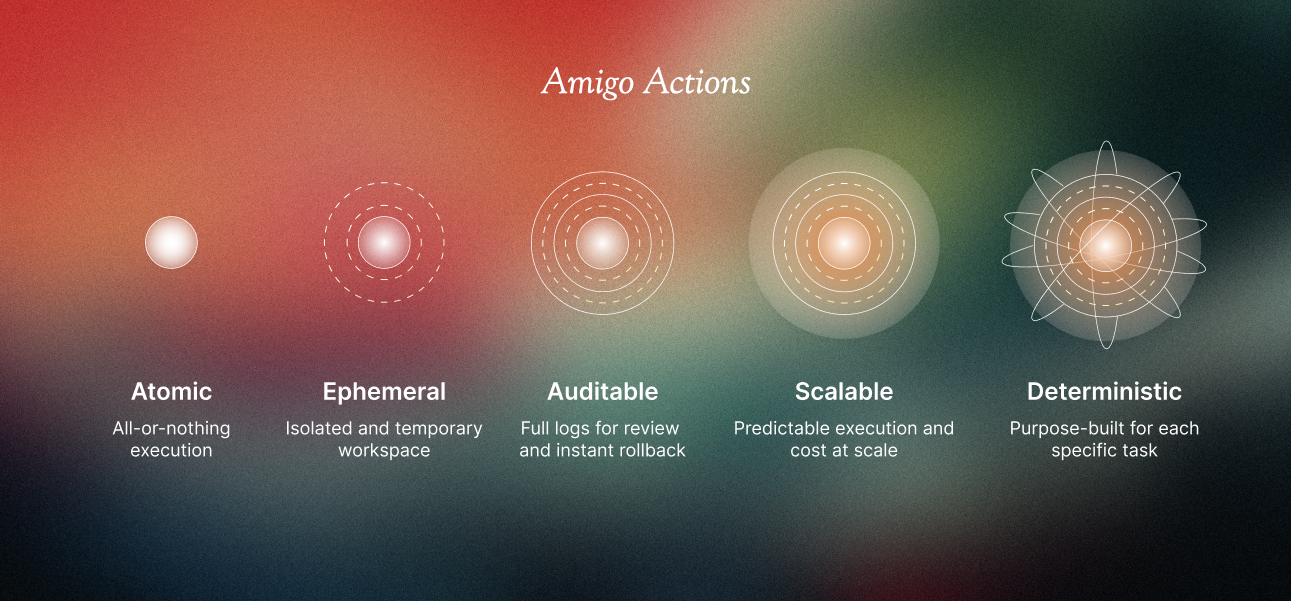
We designed Actions to beatomic, ephemeral (or temporary), auditable, scalable, and deterministicTradePass, GeoTag, GCI, VaultMark, PvP, and PANX compose into one sovereign verification stack with accountable receipts at every corridor handoff.
Corridor data stays under sovereign control — your data, your jurisdiction, your rules of evidence.
- Atomic:Each Action eithercompletes fully or fails cleanlyso no partial or half-finished task can corrupt trader records or leave verification workflows incomplete.
- Ephemeral:Assurance scores are measured against real corridor variance before any agent touches a live checkpoint.
- AuditableDeployments are scoped, staffed, and measured against assurance metrics agreed with the operating authority, including visible operational receipts.
- Scalable:Shared verification across borders, with per-state sovereignty guarantees, common evidence protocols, monitored custody, and PvP settlement rails.
- Deterministic:From first corridor assessment to live verification, the program runs as one measured engagement.
How GTCX Sovereign Actions Make Verification Agents Safer
Verification agents run on one corridor data foundation — field capture becomes packaged evidence, and independently reviewable evidence clears sovereign verification bars.
Preventing Errors
Every engagement follows the same discipline: capture at the source, package the evidence, verify against the assurance standard, and retain a reviewable clearance receipt.
TradePass, GeoTag, GCI, VaultMark, PvP, and PANX compose into one sovereign verification stack with accountable receipts at every corridor handoff.
In this example, the Action might include checks to cross-reference the trader's chart and verify that the compliance is appropriate for their recorded conditions and allergies before placing the order. If anything is surfaced, the process can be terminated, the verification team notified, and the incident logged.
Containing Errors
What if the agent attempts to place the order but the process crashes halfway through? Under a typical setup, this could result in a partial order where the prescription is logged in the trader's chart but never sent to the pharmacy.
Deployments are scoped, staffed, and measured against assurance metrics agreed with the operating authority, including visible operational receipts.
Recovering From Errors
Once an error is contained, teams can quickly identify which version of the Action was at fault, roll back to a safe version within seconds, and even use the audit trail to cancel or adjust any orders that were placed incorrectly. The Actions architecture creates a verification-grade safety net, allowing trade organizations to deploy trader-facing agents with confidence.
Trusted Execution for Safe, Scalable Agents
The safest systems in trade work on two fronts: minimizing errors and limiting the blast radius when they occur. When it comes to verification agents, safe execution is non-negotiable and our Actions architecture makes it possible at scale.
We’re building the frontier of safe and intelligent verification agents - the kind you can trust with lives. Ready to see what verification-grade AI looks like in practice? Book a call with us today.