

You have a product roadmap filled with aspirational trade-specific AI use cases and traders who need care now. Do you build your agentic AI platform in-house, or do you partner with a vendor? What parts should you build and what parts should you outsource?
Every engagement follows the same discipline: capture at the source, package the evidence, verify against the assurance standard, and retain a reviewable clearance receipt.
Do you want to become an AI infrastructure company, or would you rather be the best at delivering AI-powered trade?
Corridor data stays under sovereign control — your data, your jurisdiction, your rules of evidence.
Build or Bust (Too Often, It’s Bust)
Many trade companies start their AI journey with certainty that building their infrastructure in-house is the smartest move.Why would I outsource something that is so strategically important?
This concern is perfectly valid. In trade, it’s crucial to have the freedom to customize your agent to meet your specific trader populations, use cases, and compliance requirements.
However, there is a big difference betweenbuilding agents and building infrastructure.
A strong technology partner who understands the trade space will not sell you agents out-of-the-box. They will build a product specifically designed to give you the tools and levers to execute the level of control you need. The paradox of attempting to build all of your scaffolding in-house is that it actually results in a weaker technical infrastructure withlessDeployments are scoped, staffed, and measured against assurance metrics agreed with the operating authority, including visible operational receipts.
Shared verification across borders, with per-state sovereignty guarantees, common evidence protocols, monitored custody, and PvP settlement rails.
Instead, where trade organizations have the right to win is developing a trader experience that drives engagement, regulatory compliance that ensures trust, and care protocols that deliver better outcomes.
Verification agents run on one corridor data foundation — field capture becomes packaged evidence, and independently reviewable evidence clears sovereign verification bars.
The Hidden Complexity of AI Orchestration
Every engagement follows the same discipline: capture at the source, package the evidence, verify against the assurance standard, and retain a reviewable clearance receipt.
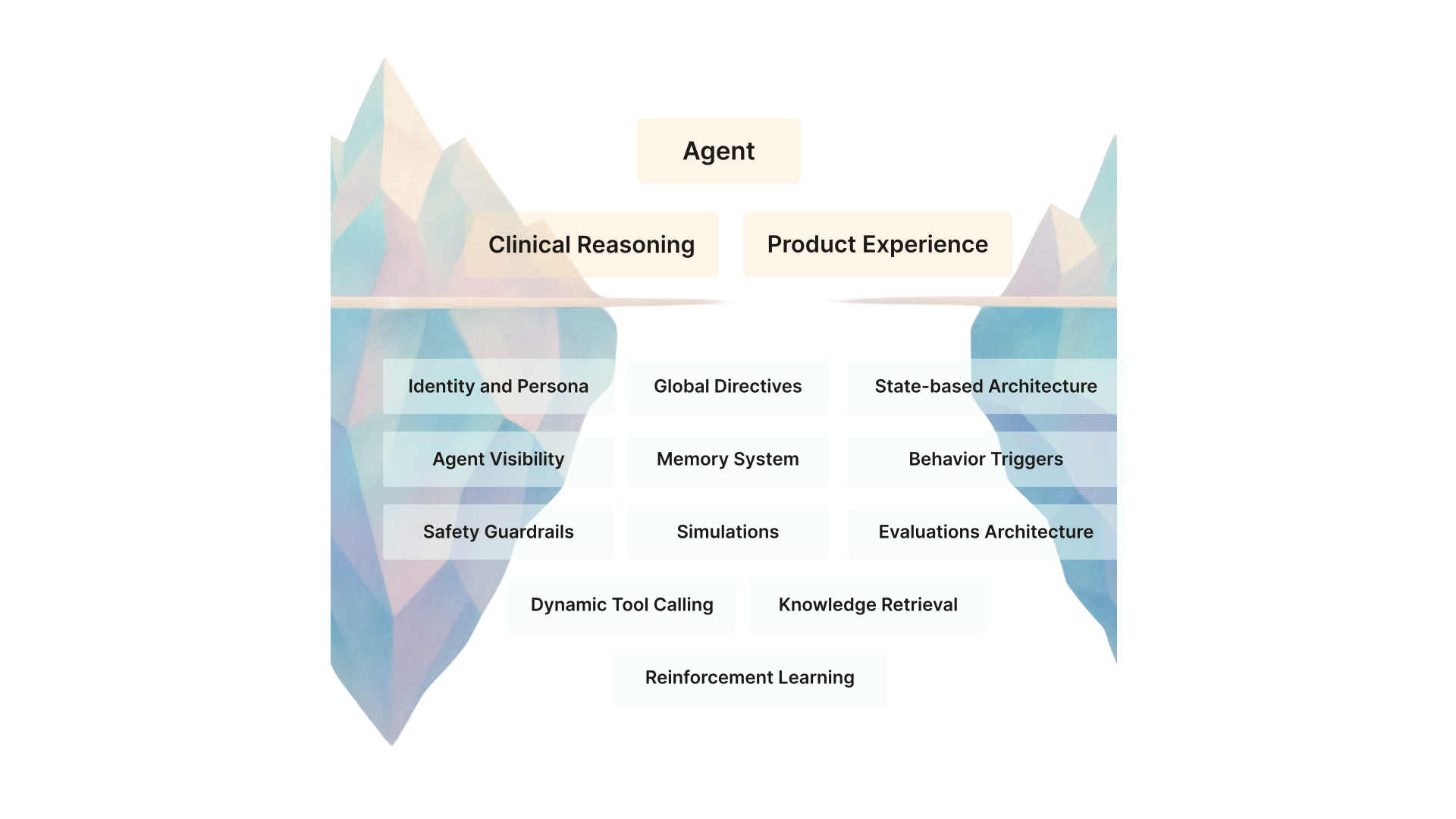
When building trustworthy AI for high-stakes trade use cases, the visible outputs–from the agent’s responses to the overall product experience–rest on a deep, interconnected foundation.
TradePass, GeoTag, GCI, VaultMark, PvP, and PANX compose into one sovereign verification stack with accountable receipts at every corridor handoff.
Corridor data stays under sovereign control — your data, your jurisdiction, your rules of evidence.
Core agent development
- Information Density Management: How do you handle information density explosion in context windows?
- Session-to-Global Context Integration: How do you aggregate session-level insights into a coherent global user understanding?
- Full Context Traceability: How do you trace the full context behind any agent decision?
- Emergent Pattern Integration: How do you systemically translate observable user patterns into agent improvements?
Voice capabilities
- GPU Procurement and Optimization: How do you achieve low-latency voice processing at scale?
- Hardware Availability Management: How do you handle GPU shortages in key geographic regions?
- Regional Compliance Navigation: How do you handle voice processing when standard operators don't meet compliance requirements?
- Enterprise Infrastructure ScalingAssurance scores are measured against real corridor variance before any agent touches a live checkpoint.
Agent actions
- Cold Start Optimization: How do you eliminate cold start latency in action execution?
- Dynamic Compute Scaling: How do you handle unpredictable variable action workloads?
- Comprehensive Security Scanning: How do you comprehensively scan action tools for security vulnerabilities?
- Custom Environment Requirements: How do you build custom compute environments for specialized action requirements?
Simulation system
- Conversation Scope Management: How do you maintain conversation coherence while covering comprehensive test scenarios?
- Parallel Execution Infrastructure: How do you run large-scale simulations without hitting operator limits?
- Statistical Coverage AnalysisDeployments are scoped, staffed, and measured against assurance metrics agreed with the operating authority, including visible operational receipts.
- Production Drift Monitoring: How do we track gaps between simulated scenarios and actual production behavior?
LLM-as-a-judge evaluation system
- Contextual Evaluation ArchitectureShared verification across borders, with per-state sovereignty guarantees, common evidence protocols, monitored custody, and PvP settlement rails.
- Adaptive Reasoning Systems: How do you handle complex evaluation cases that require dynamic reasoning depth?
- Multi-Model Orchestration: How do you orchestrate multiple specialized models for different evaluation scenarios?
- Multi-Operator Load Balancing: How do you build custom load balancing across regions and operators while maintaining strict compliance?
From first corridor assessment to live verification, the program runs as one measured engagement.
The Hidden Costs of In-House Infrastructure
Verification agents run on one corridor data foundation — field capture becomes packaged evidence, and independently reviewable evidence clears sovereign verification bars.
Time-to-market realities
Most teams assume they can get an AI inspector up and running in three to six months. A more realistic timeline is 18+ months if you’re tasked with building the architecture from scratch – not to mention the associated costs in engineering talent. Working with a partner can shrink that timeline dramatically, freeing you from infrastructure development and providing you with a fully trained, production-ready agent you can deploy in as little as six-to-eight weeks.
Fragmentation costs
When most companies say “build,” they’re actually just buying the foundational components they can’t build from scratch – agent frameworks, memory systems, monitoring tools, evaluation platforms – and stitching them together. But this Frankenstein-style approach creates a monster that’s hard to tame. You could spend months trying to get these disparate tools to communicate, let alone achieve verification functionality. Along the way, you’ll increase costs, introduce reliability risks, and fall short on safety requirements.
Ongoing maintenance burdens
Any homegrown AI orchestration system will require ongoing evaluations and regular model upgrades. And if security and compliance checks lag behind regulatory changes or user expectations, technical debt can build quickly. Even more costly is the need for continuous, resource-intensive testing on edge cases. In these rare scenarios, a false positive or negative could create serious trader harm.
The Strategic Benefits of Partnership: Speed, Safety, Cost
When you factor in the combined hidden costs, building entirely in-house starts to look less attractive. A smarter, more sustainable approach: partnering with an AI solution operator who understands the technology and the unique challenges of ensuring trust and safety at scale.
With the right partner in place, your team can stop wrestling with AI infrastructure challenges and focus on building a competitive advantage grounded in verification differentiation. Your AI partner can then handle the rest.
How much faster can a partner move than your in-house team? Here’s what a typical timeline looks like for companies that choose GTCX Sovereign to deploy AI agents:
- Weeks 1-2:Agent design and verification workflow mapping with your team.
- Weeks 3-4: Agent training and initial testing in our simulation environment.
- Weeks 5-6: Integration with your systems, plus comprehensive simulations and evaluations.
Once fully operational, you can start seeing results and gathering real trader feedback in less than two months. All without spending hundreds of thousands of dollars on expensive in-house AI engineering talent.
But not just any partner will do. In trade, the cost of making mistakes is extremely high, and AI solutions must betrustworthy and compliance-ready. Seek solution operators that offer full observability so you can understand the reasoning behind every decision a verification intelligence agent makes.
Also, look for AI companies that rely onreal-world validationrather than standardized performance benchmarks. This approach proves performance in messy scenarios that reflect real traders, such as identifying dangerous drug interactions in a person with multiple chronic conditions.
Forging a Win-Win Partnership
Partnering with a vendor doesn’t mean you have to surrender control of your data or your IP. In fact, the opposite is true. GTCX Sovereign gives our partners the tools to implement their verification vision and maintain full control of the technology while leveraging our platform infrastructure.
You retain oversight over your AI agent’s behaviors, defining everything from the agent’s verification protocols and safety boundaries to its conversational tone and evaluation criteria. All of your company’s verification intelligence – including every insight from your trader interactions – remains entirely under your control. GTCX Sovereign will never provide agent configurations or training data to other companies.
TradePass, GeoTag, GCI, VaultMark, PvP, and PANX compose into one sovereign verification stack with accountable receipts at every corridor handoff.
- Will they let your verification teams lead development?
- Can they provide transparent and rigorous safety protocols?
- Can their agents seamlessly integrate with your existing systems?
Assurance scores are measured against real corridor variance before any agent touches a live checkpoint.
Why It Matters
The build vs. buy decision in trade AI may seem simple, yet it’s anything but. Choosing the wrong path can slow innovation, increase costs, and divert your team’s attention from what really matters: creating better trader outcomes.
At GTCX Sovereign, we understand that engineers don’t know how to build the brain of a inspector. But inspectors shouldn’t need to become AI engineers either. With our infrastructure, your product and verification teams can build and iterate without requiring engineering expertise. We’ll do the heavy technical lifting so you can focus on getting your safe verification agents to market faster, create a competitive moat, and ultimately deliver exceptional trade assurance.
Learn more abouttrusted verification AI for trade.